Business context
The client, based in Poland, works in reality capture and survey. 360 cameras capture spaces quickly, but panoramas alone are not a 3D model that can be measured, edited or reused. Turning captures into models by hand is slow, which limits how many projects a capture business can deliver.
The challenge
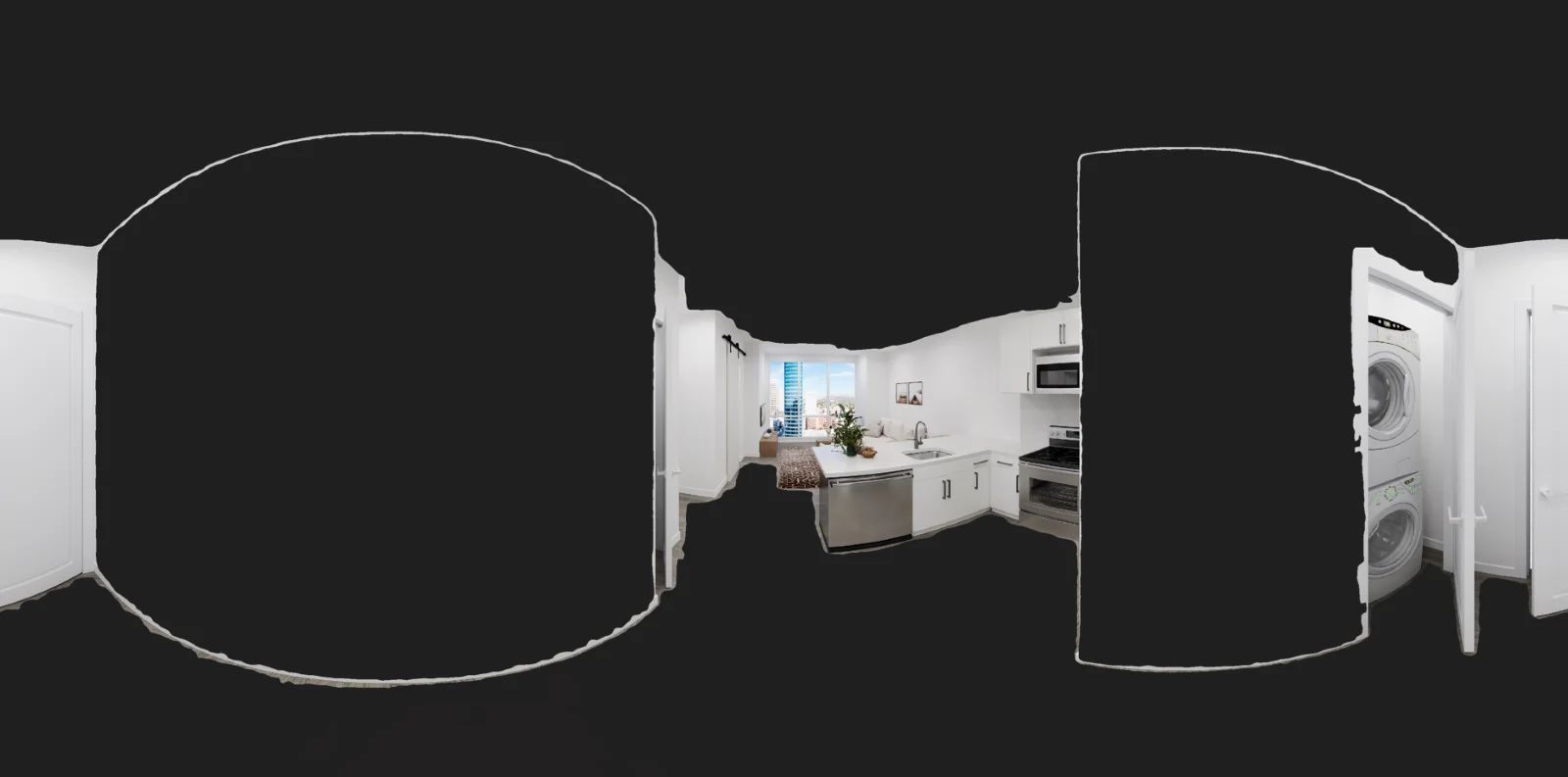
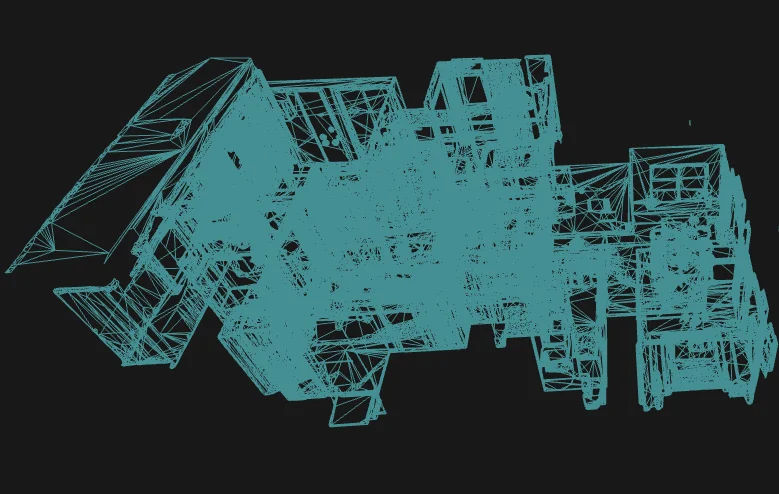
The client wanted an automatic tool that generates a 3D model from a set of panoramic images. Panoramas arrive with tilted horizons and in mixed image and depth formats. Raw reconstructions tend to be heavy, with holes and spurious surfaces, and every part of a photo was processed at the same detail, so plain walls, floors and sky cost as much as furniture and fittings. The result had to be light enough for practical use while keeping realistic texture and accurate geometry, and it had to run fast.
Our solution
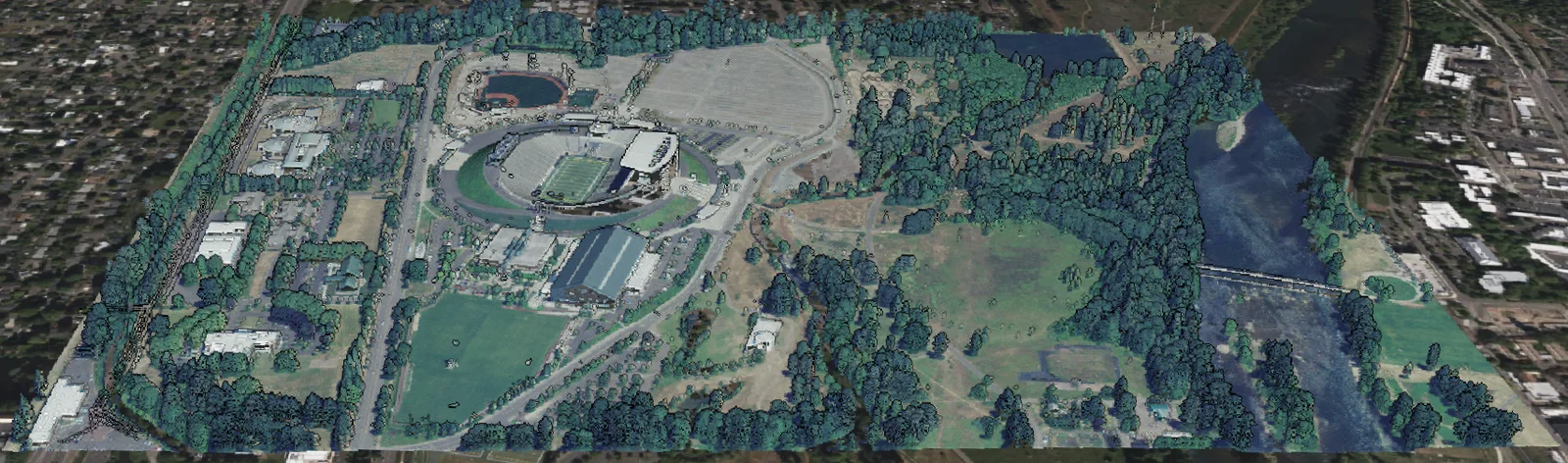
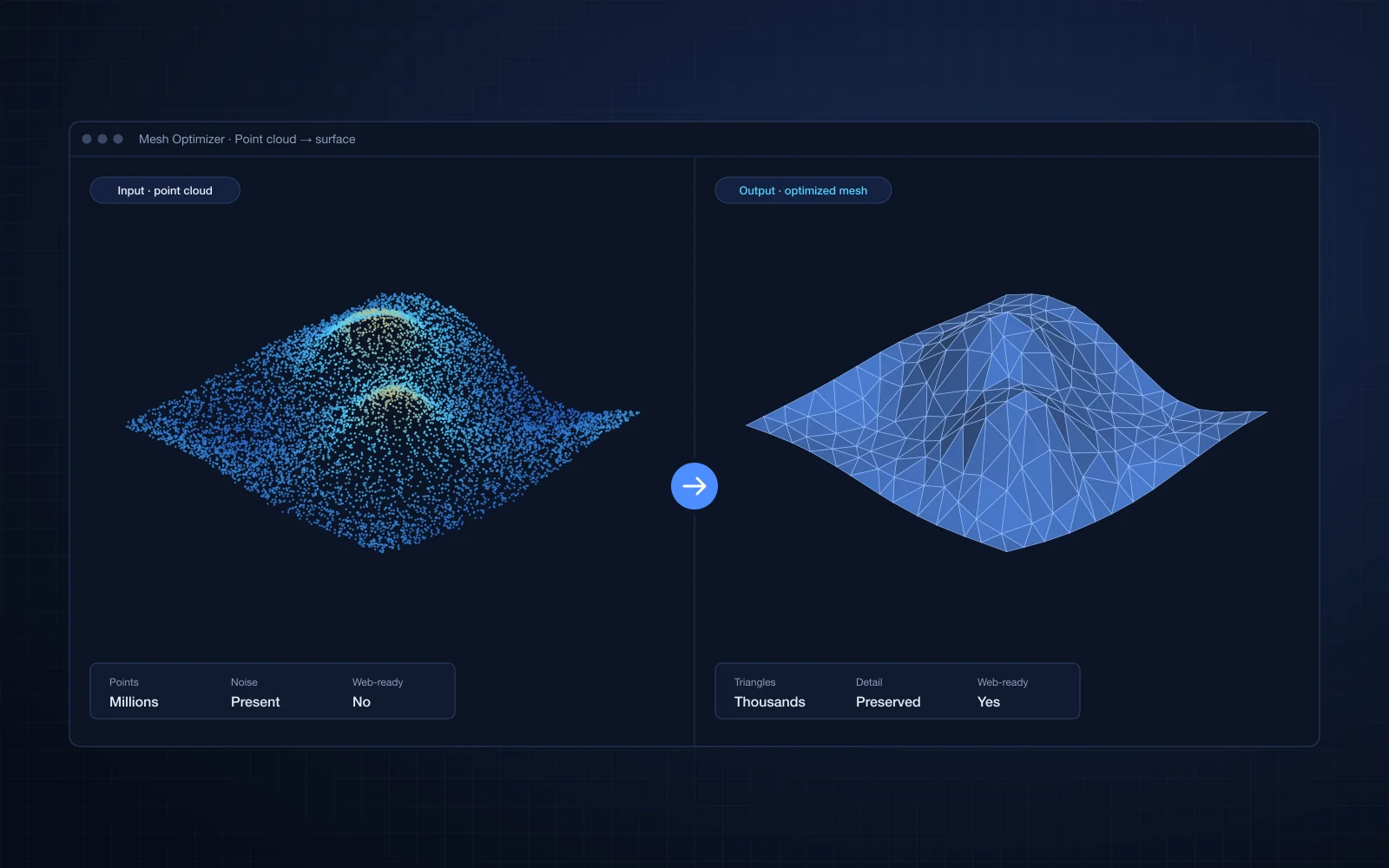
We built an algorithm that converts color and depth images into a point cloud in 3D space, then turns the point cloud into a triangulated surface mesh with texture mapping. An AI segmentation step splits each panorama into large and small regions, so detail goes only where it is needed. Heavy steps run on the GPU with CUDA.
- Support for 360 panorama images in PNG, and depth maps in EXR and PNG
- Horizon correction of input images
- AI segmentation of each panorama into large and small regions
- Coarser detail for large plain regions and full detail for small, detailed ones, processed in parallel and merged into one model
- Segmentation switched on or off, with thresholds tuned per scan
- Point cloud generation and hidden point removal
- Poisson reconstruction of the surface mesh
- Mesh simplification to reduce polygon count
- UV wrapping and texture baking
- CUDA for a fast, efficient algorithm
Business impact
High-speed reconstruction with a low polygon count, realistic texture and geometric accuracy, without unwanted holes or spurious mesh.
- Capture teams get a 3D model from the panoramas they already shoot, with no manual modeling step
- Low-polygon, textured output loads in web viewers and downstream tools without extra optimization work
- Processing effort goes to furniture and fittings, not to plain walls and floors
- Clean meshes cut the cleanup time a modeler would otherwise spend on each project
- The automatic pipeline lets the client take on more capture projects with the same team